



Latvia's immigration framework distinguishes clearly between short-term visitors and individuals seeking longer-term residence or employment. For third-country nationals-citizens of countries outside the European Union, European Economic Area, and Switzerland-this system revolves around obtaining the appropriate residence permit and, where applicable, work authorization before commencing employment or residing beyond 90 days.
Want to hear what other clients
are saying about us?

The Office of Citizenship and Migration Affairs (OCMA), known locally as PMLP (Pilsonības un migrācijas lietu pārvalde), generally oversees immigration-related administration under the Immigration Law of the Republic of Latvia, including the documentation and control of third-country nationals and the issuance of residence permits. Cabinet regulations may supplement the law by setting out specific procedures, but the Immigration Law is the primary legal basis for OCMA’s role.
All residence permit decisions, renewals, and address registrations ultimately flow through OCMA or its regional offices. The Ministry of Interior supervises OCMA's operations and sets broader immigration policy directives.
Under Schengen Area rules, visa-exempt third-country nationals may generally enter Latvia without a visa, while other eligible third-country nationals may enter with a short-stay Schengen visa (Type C). In either case, the standard limit is up to 90 days within any 180-day period.
Once this 90-day window is exhausted, the individual must either leave the Schengen Area or hold a valid long-stay visa or residence permit to remain legally.
Any stay exceeding 90 days for purposes such as employment, business activity, study, or family reunification requires a formal temporary residence permit issued by OCMA. The Immigration Law establishes specific grounds for temporary residence, each with distinct eligibility criteria, financial thresholds, and documentation requirements.
These grounds include employment, business ownership, investment, family reunification, study, and-more recently-remote work under the digital nomad visa.
Each category requires applicants to demonstrate financial sufficiency, secure valid health insurance, provide proof of accommodation in Latvia, and in most cases submit a clean criminal record certificate from their country of residence. Applications for temporary residence permits are typically submitted at Latvian embassies or consulates abroad.
In limited circumstances, such as family reunification or certain intra-company transfers, applications may be submitted directly with OCMA within Latvia.
Processing times generally range from one to two months, though cases involving business registration, investment verification, or complex employment arrangements may take longer. Because procedural requirements vary significantly by permit category and applicant circumstances, legal counsel typically manages the application sequencing-coordinating document apostille timings with embassy appointments and OCMA processing windows to prevent administrative rejections.
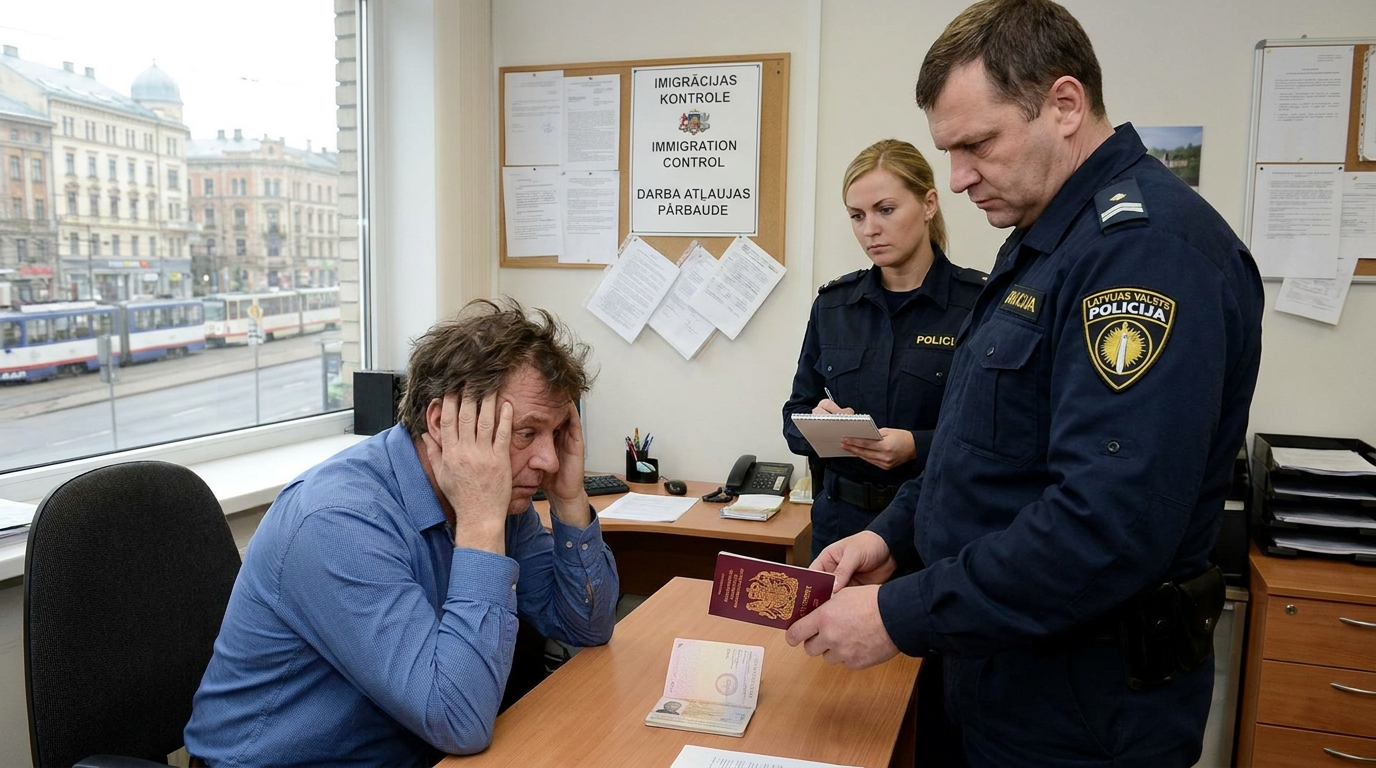
1. Can a British citizen work in Latvia on a short-stay visa or do I need a work permit?
British citizens cannot work in Latvia on a short-stay visa.
Since Brexit, UK nationals generally need appropriate permission to work in Latvia, but the exact requirement depends on the length and nature of the stay. While UK citizens can usually visit the Schengen area for up to 90 days in any rolling 180-day period for certain short activities, work in Latvia may require a visa, work permit, or residence permit, and a temporary residence permit is typically needed only in longer-term work situations or where Latvian rules specifically require it. UK nationals who were legally resident in Latvia before 1 January 2021 may also retain protected rights under the Withdrawal Agreement.
A Schengen visa (Type C) allows third-country nationals-including British citizens-to enter Latvia and travel throughout the Schengen Area for up to 90 days within any 180-day period. This short-stay visa is issued for tourism, business visits, or family visits.
It does not grant the right to engage in paid employment in Latvia, regardless of the applicant's home country. The Type C visa expires after the permitted stay, and its holder must leave the Schengen Area unless they hold a separate long-stay authorization.
A Type D visa (long-stay visa) is issued for stays exceeding 90 days but functions primarily as a transitional travel document. It permits the holder to enter Latvia and remain in the country while their temporary residence permit application is being processed by OCMA, typically for up to 90 days.
The Type D visa is not itself a residence permit. Rather, it serves as the initial authorization that allows applicants to wait in Latvia during the approval period, after which they receive the formal residence permit card.
A temporary residence permit is a legal status granting the holder the right to reside in Latvia for a specified period, usually one to five years depending on the grounds of application. The permit is evidenced by a physical residence permit card issued by OCMA.
This card serves as proof of legal residence and, in cases where the permit is granted on employment or business grounds, also confirms work authorization. Holders of a temporary residence permit must renew their permits before expiration and may apply for permanent residence after five years of continuous legal residence in Latvia.
2. Main Types of Residence and Work Permits in Latvia
Latvia offers several immigration pathways for third-country nationals seeking to live and work in the country. Each route has distinct eligibility requirements, financial thresholds, application procedures, and renewal conditions. The appropriate permit depends on the applicant's qualifications, employment situation, business intentions, investment capacity, or remote work arrangements.
This section provides a structured overview of the primary residence and work permit categories available to foreign nationals. It is designed to help you identify the correct route for your circumstances rather than provide exhaustive procedural detail, which is covered in linked supporting articles.
3. Employment Permits and the EU Blue Card
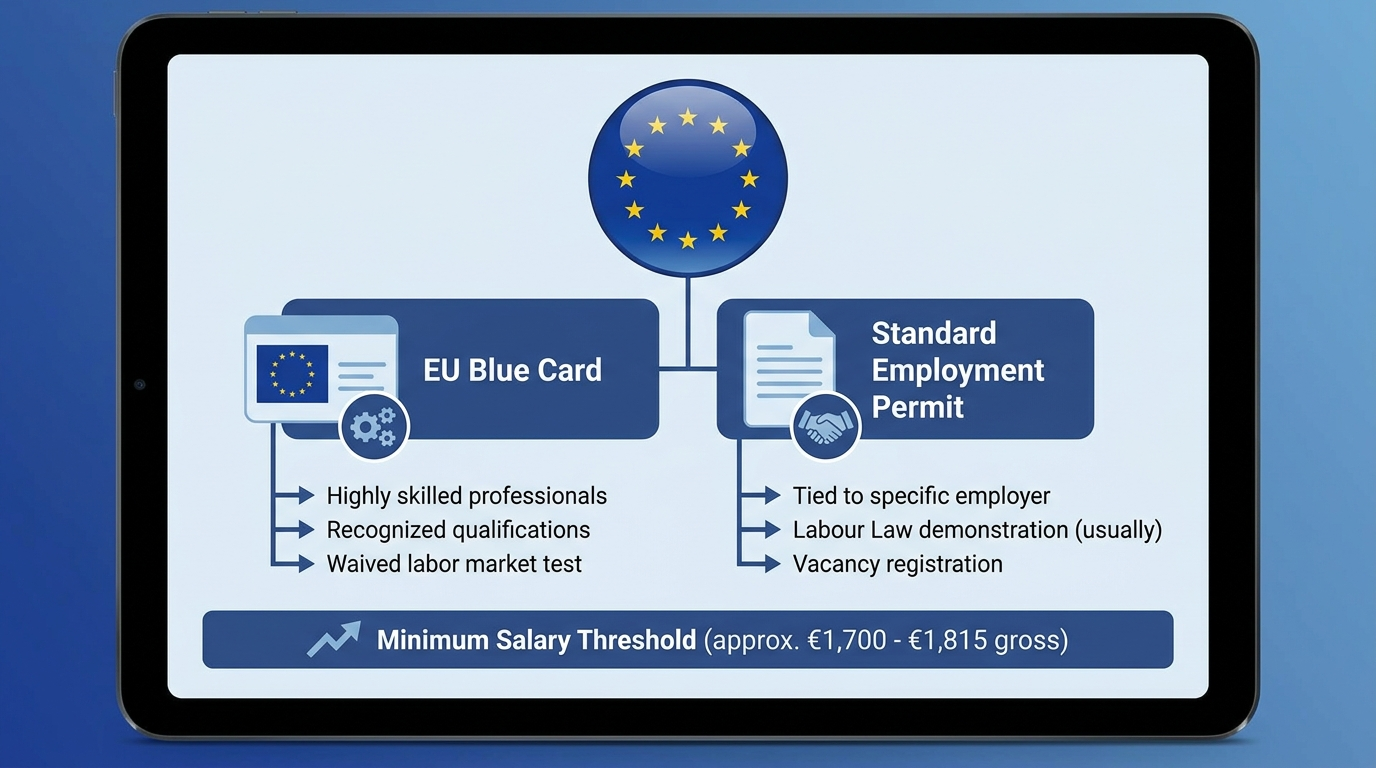
Latvia distinguishes between standard work-based residence permits and the EU Blue Card, a specialized permit designed for highly skilled professionals with recognized qualifications and job offers in eligible occupations.
A standard employment residence permit is tied to a specific employer and requires a valid employment contract with a Latvian company or a foreign entity operating in Latvia.
The employer must generally demonstrate that the position cannot be filled by an EU/EEA national under the Labour Law, though this requirement is waived for certain high-demand roles listed by the State Employment Agency (NVA) or for specialized positions meeting EU Blue Card criteria.
The applicant must meet minimum salary thresholds set by Cabinet Regulation No. 731 of 26.11.2024, which as of 1st April 2026 are set at 1.2 times the average gross monthly salary in Latvia-approximately €1,700 gross per month (approx. €1815 per month).
Because NVA labor market tests require precise formatting of job descriptions and proof that local recruitment efforts were genuinely exhausted, legal counsel typically manages this vacancy registration directly with the agency, ensuring the job description matches the applicant's official qualifications to prevent processing delays. The permit is typically issued for one year initially and can be renewed based on continued employment and compliance with residency and tax obligations.
| Permit Type | Minimum Gross Salary | Qualifications Required | Initial Validity |
|---|---|---|---|
| Standard Employment Permit | €1,700/month (1.2× average) | Job offer; employer sponsorship | 1 year (renewable) |
| EU Blue Card | €2,500/month or €30,000/year (1.5× average) | Higher education degree; highly skilled role | Up to 2 years (renewable) |
The EU Blue Card, established under EU Directive 2009/50/EC and implemented in Latvia through the Immigration Law, is available to third-country nationals who hold a recognized higher education qualification (at least a bachelor's degree or equivalent) and have a job offer in a highly skilled occupation.
To qualify, the applicant's gross annual salary must meet or exceed 1.5 times the average annual gross salary in Latvia-approximately €24,720/year or €2,723/month, as of 2026.
The EU Blue Card provides several advantages over standard work permits, including greater mobility within the European Union after 18 months of residence, faster pathways to permanent residence in Latvia and other EU member states, and the ability to bring family members under more favorable conditions.
The EU Blue Card is generally issued for the employment period and may be valid for up to five years. In some cases, EU-level rules allow the card to be issued for the contract period plus three months if the employment contract is shorter, so the exact duration depends on the applicable contract and residence-permit rules.
Both routes require proof of financial sufficiency, valid health insurance covering the entire period of stay, and submission of a clean criminal record certificate from the applicant's country of residence or current place of residence if different. Applications are generally submitted abroad through Latvian embassies or consulates, though in-country applications may be permitted in specific cases such as intra-company transfers or permit renewals.
Employer sponsorship is a central requirement under the Labour Law, and the State Employment Agency plays a key role in verifying that the employment contract meets regulatory standards and that the vacancy registration process has been completed where applicable.

4. Business, Investor, and Start-up Visas
Foreign nationals who wish to establish a business, make an investment, or launch an innovative start-up in Latvia have several residence permit options depending on the nature, scale, and structure of their activity.
A business residence permit under the Immigration Law is available to individuals who establish and register a company with the Commercial Register and demonstrate that the business will contribute meaningfully to the Latvian economy. Applicants must show that their company has sufficient capitalization, a viable business plan, and the capacity to generate employment, tax revenue, or other economic benefits.
There is no universally fixed minimum investment amount for this category, but applicants must prove financial self-sufficiency and the legitimacy of their business operations.
OCMA evaluates whether the business is genuine, sustainable, and likely to continue operating throughout the permit's validity. Because OCMA scrutinizes source-of-funds documentation and cross-references Commercial Register filings with State Revenue Service tax records, legal counsel typically liaises between the applicant, the Commercial Register, and OCMA to ensure all corporate formation documents align with the residence permit narrative.
A business-related residence permit does not typically have a single standard duration. In self-employment cases, the permit is generally issued for up to one year, while certain business or investment-based residence permits may be granted
for up to five years or renewed annually for up to five years if the legal conditions continue to be met.
Investor residence permits are granted to individuals who make qualifying investments in Latvian real estate, government bonds, or capital contributions to Latvian enterprises. Historically, real estate investment thresholds have been set at €250,000 or higher depending on the location, type of property, and regulatory framework in place at the time of application. These programs are subject to periodic regulatory changes and enhanced due diligence requirements.
Applicants must demonstrate that investment funds originate from legal sources, typically through bank statements, tax records, or certified proof of sale of assets. The investor residence permit does not automatically grant work authorization unless the applicant also establishes a business or obtains separate employment authorization.
The start-up visa is designed for entrepreneurs launching innovative, scalable businesses with high growth potential in Latvia. Applicants must receive formal endorsement from an authorized body confirming that their start-up meets criteria related to innovation, market potential, and economic benefit to Latvia under the Law on Supporting the Activities of Start-up Companies and implemented through provisions in the Immigration Law.
Up to five co-founders can apply under a single start-up project, each receiving an individual residence permit linked to the endorsed venture. The initial start-up visa is granted for up to three years and does not require the applicant to remain in Latvia for a minimum number of days annually, offering significant flexibility for internationally mobile founders who may need to travel frequently or maintain operations in multiple countries.
However, the business must remain active and demonstrate progress toward the stated objectives to qualify for renewal.
All business and investment routes require ongoing compliance with Latvian tax obligations, proof of legal source of funds, and in most cases registration with the State Revenue Service for personal income tax purposes. Business owners and investors are also expected to maintain valid health insurance and proof of accommodation in Latvia throughout the validity of their permits.

5. The Digital Nomad Visa
Latvia introduced a digital nomad visa under Section 23, Paragraph one, Clause 30 of the Immigration Law to attract remote workers who are employed by or provide services to companies located outside Latvia. This permit allows third-country nationals to reside in Latvia while continuing to work remotely for foreign employers or clients, without triggering the need for a Latvian work permit or employer sponsorship.
To be eligible, applicants must demonstrate that they are engaged in remote work or provide services using telecommunications technology. The work must be performed for an entity that is not registered or operating in Latvia, and the applicant may not provide services to Latvian clients or establish a business in Latvia while holding this visa.
Depending on the specific application, the digital nomad visa may require an applicant to prove a stable monthly gross income of around €2,500 (or equivalent) for as much as the preceding six months. This income requirement can be documented through employment contracts showing remote salary, freelance client service agreements, or bank statements demonstrating regular deposits that match the declared income source.
All proof must clearly show that the income originates from outside Latvia and is consistent over the required time-frame.
The digital nomad visa is issued for up to one year and can be renewed for an additional year, subject to continued compliance with the income and remote work requirements. It does not grant the right to work for Latvian employers or clients, and holders may not establish a business or register as self-employed in Latvia during the validity of the permit.
Digital nomad visa holders may generally remain in Latvia for the permit’s validity, but the visa does not by itself exempt them from Latvian tax-residency rules. In practice, individuals who spend fewer than 183 days in Latvia in any 12-month period are typically treated as non-residents for tax purposes and are usually taxed only on Latvia-sourced income, although longer stays or other residence factors may still create Latvian tax residency.
Applicants must also provide proof of valid health insurance covering the entire period of stay, proof of accommodation in Latvia (such as a rental agreement or property ownership document), and a clean criminal record certificate from their country of residence or current location.
6. Special Considerations for UK Nationals Post-Brexit
Since the United Kingdom's departure from the European Union on January 31, 2020, and the end of the transition period on December 31, 2020, UK nationals have been reclassified as third-country nationals under Latvian immigration law. This transition ended the automatic right of UK citizens to live, work, or study in Latvia without authorization.
UK nationals who wish to reside in Latvia for more than 90 days within any 180-day period must now apply for a temporary residence permit on the same legal basis as other non-EU/EEA nationals. The type of permit required depends on the purpose of stay: employment, business activity, study, family reunification, or remote work.
Key changes affecting UK nationals:
- No automatic work authorization: UK citizens can no longer enter Latvia and begin working without first securing a residence permit tied to employment. Employers must sponsor UK workers through the standard employment residence permit process, including NVA labor market approval where applicable.
- Schengen short-stay rules apply: UK passport holders may visit Latvia visa-free for up to 90 days within any 180-day period for tourism or business purposes. However, this short stay does not permit paid employment or business establishment.
- Document authentication requirements: UK-issued documents-such as criminal record certificates, educational qualifications, birth certificates, and marriage certificates- may require legalisation by the UK Foreign, Commonwealth & Development Office (FCDO) and officially translated into Latvian by a sworn translator before submission to OCMA.
- No transitional provisions for new arrivals: UK nationals who were not legally resident in Latvia before December 31, 2020, do not benefit from the Withdrawal Agreement's protections. They must follow the standard third-country national application procedures.
UK nationals who were legally resident in Latvia before the end of the transition period and registered their residence status with OCMA may be eligible for continued residence rights under the Withdrawal Agreement. These individuals should consult OCMA directly or seek legal advice to confirm their status and renewal rights.
Because post-Brexit residence permit applications require careful coordination of apostille procedures, translations, and embassy appointments-and because UK nationals often face additional scrutiny regarding their employment authorization and financial sufficiency-legal counsel frequently acts as the liaison between the applicant, the UK FCDO, Latvian consular offices, and OCMA to ensure all documentation meets technical requirements and timelines align.
7. A Step-by-Step Guide to Applying for a Latvia Residence and Work Permit
The Latvia residence permit process is a multi-stage procedure involving coordination between the applicant, their sponsoring employer or business, Latvian consular offices abroad, the State Employment Agency (NVA), and the Office of Citizenship and Migration Affairs (OCMA). Each stage has specific documentation requirements, strict formatting standards, and processing timelines that must be followed in the correct sequence to avoid administrative rejections or delays.
This section outlines the chronological phases of a typical employment-based residence permit application, from securing a valid employment contract to collecting the physical residence permit card. While some details vary depending on the permit category-business, investment, digital nomad, or family reunification-the core application structure remains consistent: document preparation, consular submission, biometric data collection, OCMA review, and final card issuance.
Because the sequence of steps-vacancy registration with NVA, document apostille and translation, consular appointment booking, and OCMA processing windows-must occur in the correct order, independent legal counsel typically positions itself as the liaison who manages this specific application filing to prevent administrative delays with the State Employment Agency (NVA) and OCMA.
This coordination ensures that employer obligations, consular requirements, and immigration deadlines align without gaps or overlaps that could delay approval.
Securing an Offer and State Employment Agency (NVA) Approval
Before a third-country national can apply for an employment-based residence permit, the Latvian employer must register the vacancy with the State Employment Agency (NVA) and obtain approval confirming that the position cannot reasonably be filled by an EU/EEA national already residing in Latvia.
This labor market test is a mandatory precondition for standard employment permits, though exemptions apply to certain high-demand occupations, EU Blue Card holders, highly skilled specialists, and intra-company transferees.
The State Employment Agency (NVA) reviews the job description, required qualifications, salary offered, and any evidence the employer has provided demonstrating unsuccessful attempts to recruit locally. The employer must submit a vacancy registration form detailing the position's duties, minimum qualifications, and proposed salary.
The NVA evaluates whether the role genuinely requires specialized skills or experience that are not readily available in the local labor market.
Because NVA labor market tests require precise formatting of job descriptions and proof that local recruitment efforts were genuinely exhausted, legal counsel typically manages this vacancy registration directly with the agency, ensuring the job description matches the applicant's official qualifications to prevent processing delays.
If the NVA determines that the role justifies hiring a third-country national, it issues a positive decision, and the employer is authorized to proceed with sponsorship. The approval is documented in a letter or certificate, which becomes a required supporting document in the residence permit application.
Key points about NVA registration:
- Mandatory for standard employment permits: NVA approval is required for most employment-based residence permits unless the position falls under an exemption category.
- Exemptions apply to: EU Blue Card holders, highly skilled specialists in shortage occupations, intra-company transferees, seasonal workers in specific sectors, and certain managerial roles.
- Salary verification: The employer must demonstrate that the salary meets or exceeds the minimum threshold for the permit type (approximately €1,700 gross per month for standard permits, €2,500 for the EU Blue Card as of 2026).
- Processing time: NVA review typically takes 2-4 weeks, though complex cases or high-demand periods may extend this timeline.
- Letter of invitation: Once NVA approval is issued, the employer provides the foreign applicant with a formal letter of invitation, which must be included in the residence permit application submitted to the Latvian embassy or consulate.
Employers should initiate NVA registration as soon as a hiring decision is made, as delays at this stage directly impact the overall timeline for the foreign national's arrival and onboarding.
Submitting Documents, Biometrics, and Processing Times
After receiving the letter of invitation and assembling all required documents, the applicant submits the residence permit application at the Embassy of Latvia or Ministry of Foreign Affairs (MFA) office in their country of residence. Applications must be submitted in person at an appointment scheduled in advance through the consular office's online booking system or by phone.
Core dossier requirements (standard employment permits):
- Valid passport: Must have at least six months' validity beyond the intended period of stay and at least one blank visa page.
- Completed application form: Available from the embassy or downloadable from the Ministry of Foreign Affairs website. The form must be signed and dated by the applicant.
- Recent passport-style photographs: Two or more photographs meeting ICAO standards (white background, neutral expression, no glasses).
- Criminal record certificate: Issued by the competent authority in the applicant's country of residence, apostilled or consular-legalized, and officially translated into Latvian by a sworn translator.
- Proof of valid health insurance: Coverage must include emergency medical treatment and repatriation throughout the intended period of stay. The insurance policy must be recognized by Latvian authorities or issued by a company operating within the EU/EEA.
- Employment contract or letter of invitation: Issued by the Latvian employer, specifying the job title, gross salary, duration of employment, and start date.
- Proof of financial sufficiency: For employment permits, this is demonstrated through the employment contract showing salary. For other permit types, bank statements, tax records, or proof of investment may be required.
- Proof of accommodation in Latvia: Rental agreement, property deed, or a notarized letter from a host guaranteeing accommodation.
All documents issued outside Latvia must be apostilled (for Hague Convention countries) or legalized by a Latvian consulate, and officially translated into Latvian by a sworn translator. Translations must include the translator's official seal, signature, and contact information.
Incomplete or incorrectly formatted translations are a common cause of processing delays and refusals.
Because consular officials and OCMA reviewers reject applications with even minor formatting errors-such as missing apostille stamps, translations that do not bear the translator's official seal, or criminal record certificates that do not cover the correct time period-legal counsel often coordinates the apostille and translation sequence to ensure documents meet technical requirements before the embassy appointment.
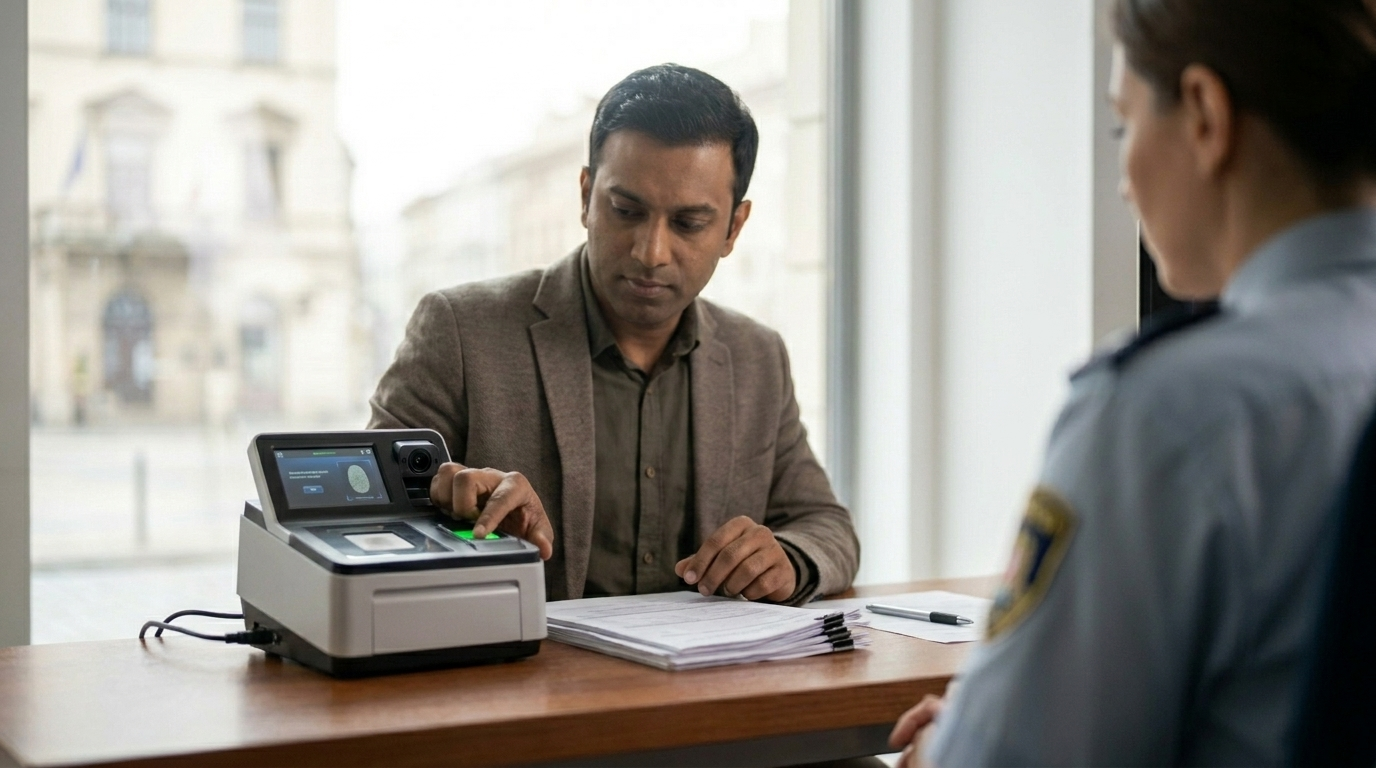
At the embassy appointment, the applicant provides biometric data: digital fingerprints and a facial photograph. This biometric information is transmitted to OCMA (the Office of Citizenship and Migration Affairs) and used to produce the physical residence permit card.
Once the application is submitted, it undergoes the following processing stages:
1. Initial consular review (1-2 weeks): The embassy or consulate verifies that all required documents are present, correctly formatted, and properly legalized. Incomplete applications are returned to the applicant with instructions for correction. 2. OCMA processing and decision (4-8 weeks): The Office of Citizenship and Migration Affairs reviews the application, verifies the applicant's eligibility, confirms the employer's registration with the State Revenue Service (VID), and cross-references the NVA approval. OCMA may request additional documentation or clarification from the applicant or employer. 3. Residence permit card production and delivery (1-2 weeks): After approval, OCMA produces the physical residence permit card using the biometric data collected at the embassy. The card is sent to the embassy or consulate for collection by the applicant.
The total timeline from application submission to receiving the physical permit card typically ranges from 6-12 weeks, though straightforward cases with complete documentation may be processed faster.
What is the processing time for a Latvia residence permit for US citizens?
US citizens should expect 6 to 12 weeks total processing time for a Latvia residence permit, measured from application submission at the embassy or consulate to final card issuance. This timeline includes initial embassy review (1-2 weeks), OCMA processing and decision (4-8 weeks), and residence permit card production and delivery (1-2 weeks after approval).
Processing times vary based on the type of permit, the completeness and accuracy of the submitted documents, the workload at the relevant embassy or OCMA office, and whether the application requires additional verification steps such as NVA labor market approval or investment fund source checks. Applicants should avoid booking non-refundable travel or making firm relocation commitments until the residence permit card is physically in hand.
8. What documents do I need to apply for a Latvia residence permit from the UK?
UK applicants need a valid passport, apostilled criminal record certificate, proof of health insurance, employment contract or proof of income, proof of accommodation, and all foreign documents officially translated into Latvian. UK citizens applying for a Latvia residence permit must submit the same core documents required of all third-country nationals, but post-Brexit, UK-issued documents require specific authentication steps.
All foreign documents must bear a Hague Apostille and be officially translated into Latvian by a sworn translator. Because UK nationals are now treated as third-country nationals for Latvian immigration purposes, they are subject to the same residence permit requirements as applicants from the United States, Canada, or other non-EU/EEA countries.
Key document authentication steps for UK applicants:
- Criminal record certificate: Obtain a Disclosure and Barring Service (DBS) certificate or equivalent from the relevant UK authority. The certificate must be apostilled by the UK Foreign, Commonwealth & Development Office (FCDO) and officially translated into Latvian.
- Educational qualifications: Diplomas, degree certificates, and transcripts must be apostilled by the FCDO and translated by a sworn translator. The translation must include the translator's official seal and contact information.
- Birth and marriage certificates: If required for family reunification or dependent applications, these documents must also be apostilled and translated.
- Health insurance: Proof of valid health insurance covering emergency medical treatment and repatriation throughout the intended period of stay in Latvia.
UK applicants should confirm that their apostille and translation documents are correctly sequenced and formatted before the embassy appointment. Because OCMA routinely rejects applications with even minor discrepancies-such as missing apostille stamps or translations that do not bear the translator's official seal-legal professionals are typically positioned as essential for coordinating document legalization to prevent technical rejections.
9. Understanding Costs, Taxes, and Ongoing Fees
Latvia's immigration system requires upfront proof of financial sufficiency, payment of state application fees during the application process, and post-arrival registration for taxation and social insurance. Understanding these financial obligations is essential for avoiding application refusals and ensuring compliance after arrival.
This section groups the financial implications of relocating to Latvia, including state application fees, mandatory salary thresholds, and subsequent tax liabilities. Because tax and social security obligations vary depending on the applicant's permit type, income sources, and length of stay, the State Revenue Service (VID) plays a central role in verifying compliance with personal income tax obligations and social insurance contributions.
Proving Sufficient Means of Subsistence
OCMA evaluates whether each applicant has adequate financial resources to support themselves (and any dependents) during their stay in Latvia. The specific threshold and method of proof depend on the type of residence permit sought.
Employment permit applicants prove financial sufficiency through their employment contract, which must meet minimum gross salary thresholds:
- Standard employment permits: Gross salary of at least €1,700 per month (approximately 1.2 times the average gross monthly salary in Latvia as of 2026).
- EU Blue Card: Gross salary of at least €2,500 per month or approximately €30,000 annually (1.5 times the average annual gross salary).
- Managers and high-level specialists: Higher thresholds may apply depending on the role and industry sector.
Salary is assessed in gross terms before tax and social insurance deductions. The employment contract must specify the gross monthly or annual salary, duration of employment, and job title. The employer's registration with the State Revenue Service (VID) is verified as part of the OCMA review process.
Business owners, investors, and digital nomads cannot rely on an employment contract. Instead, they must submit:
- Bank statements showing regular income or sufficient savings over a defined period (typically 3-6 months).
- Proof of legal source of funds for investments or business capital.
- Income declarations or tax records from the applicant's country of origin.
For example, digital nomad applicants typically need to demonstrate a monthly gross income of at least €2,500 over the preceding six months, supported by bank statements, client contracts, or employer letters.
OCMA does not accept cash deposits without a clear source, nor does it accept third-party guarantees in most cases. All income and savings must be traceable, legally obtained, and supported by documentary evidence.
10. What tax and social security registrations do I need after getting a work permit in Latvia?
You must register with the State Revenue Service (VID) for personal income tax and social insurance contributions after receiving your work permit and beginning employment. Once you hold a valid residence permit and begin working for a Latvian employer, you are required to register with the State Revenue Service (VID) for personal income tax and social insurance contributions. The State Revenue Service (VID) is the central tax authority responsible for administering personal income tax, corporate tax, VAT, and social insurance contributions in Latvia.
This registration is typically completed by your employer as part of the onboarding process, but you should confirm that it has been done and retain your taxpayer identification number (personas kods), which is used for all official interactions with Latvian tax and social security authorities.
Key post-arrival tax and social security obligations:
- Personal income tax registration: All residents earning employment income in Latvia must be registered with VID. Your employer withholds income tax at source and remits it on your behalf. For 2026, the primary progressive brackets are set between 25.5% (for annual gross income up to €105,300) and 33% (for annual income exceeding €105,300).
- Social insurance contributions: Employers are required to pay mandatory social insurance contributions on behalf of employees, covering health insurance, pensions, and unemployment benefits. Employees also contribute a portion of their gross salary. Your residence permit card and taxpayer number are used to verify your eligibility for public services.
- Tax residency status: If you spend 183 days or more in Latvia within a calendar year, you become a Latvian tax resident and are subject to taxation on your worldwide income. If you remain below this threshold, you are generally taxed only on Latvian-source income. Digital nomads and remote workers should monitor their days carefully to avoid unintended tax residency.
- Annual tax returns: Most employees do not need to file an annual return if their only income is employment income taxed at source. However, self-employed individuals, business owners, and those with foreign income must file an annual declaration with VID.
Because the 183-day physical presence rule triggers worldwide tax residency in Latvia, this represents a significant compliance risk for remote workers or digital nomads who maintain income sources in multiple jurisdictions. If you exceed this threshold, you are required to declare and pay tax on all global income, including foreign employment, rental income, dividends, and capital gains.
Failure to comply can result in tax penalties, interest charges, and difficulty renewing your residence permit.
Failure to comply can result in tax penalties, interest charges, and difficulty renewing your residence permit. Because cross-border tax compliance involves multiple reporting obligations and treaty considerations, legal counsel or a cross-border tax advisor typically coordinates VID registration and annual filing requirements to prevent administrative penalties and ensure proper worldwide income reporting.

11. Bringing Family: Rules for Dependents and Spouses
Latvia's Immigration Law permits primary residence permit holders to sponsor eligible family members for dependent residence permits.
Under Latvia’s family-reunification framework, spouses and minor children are generally the core eligible dependents, but the rules are not limited to those categories alone. In some cases, unmarried minor children, adult dependent children with health or disability-related limitations, and even dependent parents or grandparents may also qualify under the applicable legal provisions.
EU Blue Card holders benefit from more streamlined family reunification procedures under EU Directive 2009/50/EC, as implemented in Latvia. Blue Card holders may apply for family reunification immediately upon receiving their card, without waiting for a minimum period of residence. Spouses and minor children of Blue Card holders are also granted faster processing times and, in most cases, open work authorization without needing separate labor market approval.
Standard employment permit holders and other temporary residence permit holders may sponsor family members, but the primary applicant must demonstrate sufficient financial means to support the entire household. OCMA applies an augmented income threshold: the base salary requirement for the primary permit holder, plus an additional percentage for each dependent. For example, if the standard employment permit requires a gross monthly salary of €1,700, the threshold for a permit holder with one dependent may rise to approximately €2,200, and higher still for additional dependents. The exact calculation depends on the number of dependents and the permit category.
Required documents for dependent applications typically include:
- Valid passport for each dependent
- Birth certificates for children, apostilled and officially translated into Latvian
- Marriage certificate (for spouses), apostilled and translated
- Proof of family relationship and dependency
- Proof of accommodation in Latvia sufficient for the entire family
- Valid health insurance covering all family members
- Criminal record certificate for adult dependents (usually spouses over 18)
Because OCMA reviews dependency relationships carefully-cross-referencing birth and marriage certificates with tax records, household registration, and the primary permit holder's income statements-legal counsel typically manages the family reunification application to ensure all documents are correctly authenticated, translated, and sequenced to prevent processing delays or refusals based on minor formatting errors.
Processing times for family reunification applications are generally similar to those for primary permits: 6-12 weeks from submission to approval. However, incomplete documentation or failure to meet the augmented financial threshold can result in refusals or requests for additional evidence, extending the timeline significantly.
: Detailed dependency proofs, income calculations for specific family configurations, school enrollment procedures for children, and spouse work authorization pathways are best covered in a dedicated family reunification guide.
12. Post-Arrival Steps: Settling in Latvia
Once OCMA approves your residence permit and issues your permit card, you must complete several administrative steps to establish your legal residence in Latvia and integrate into the social and tax systems. These post-arrival obligations are mandatory and must be completed within strict deadlines to avoid penalties or complications when renewing your permit.
Where do I register my address in Latvia after getting a residence permit and starting work?
You can register your declared address (dzīvesvietas deklarēšana) at the local municipality office where you reside, online via latvija.lv within one month of receiving your residence permit card. In Latvia, all residents-citizens and foreign nationals alike-are required to declare their place of residence with the municipal authority responsible for the address where they live. This registration process, known as dzīvesvietas deklarēšana, is a legal obligation under Latvian administrative law and serves multiple purposes: it establishes your official address for tax purposes, links you to local public services, and provides OCMA with updated contact information.
How to register your address:
- Your valid passport
- Your residence permit card
- Proof of accommodation (rental agreement, property deed, or a letter from your landlord or host confirming that you live at the address)
- If you are renting, the landlord may need to provide written consent for your registration at the property
This document is sometimes required when opening a bank account, enrolling children in school, or applying for services.
Alternative: Online registration through the e-government portal
If you have access to a secure electronic signature (eParaksts), you can register or update your declared address online through Latvia's official e-government portal. This option is available to those who have obtained a Latvian digital signature certificate, which requires an in-person visit to a certification authority and is typically easier to arrange after you have been living in Latvia for some time.
Most new arrivals complete their first address declaration in person at the municipality.
Important deadlines and compliance:
- You must register your address within one month of receiving your residence permit card or within one month of moving to a new address.
- Failure to register or update your address can result in administrative fines and may complicate renewal applications, as OCMA uses your declared address to send official correspondence.
- If you move to a new address within Latvia, you are required to update your declaration within one month of the move.
Because the address declaration system is decentralized-each municipality operates its own registration office with slightly different procedures-legal counsel or relocation advisors often accompany new arrivals to the first registration appointment to ensure the process is completed correctly and all documents are accepted without delays.
Other immediate post-arrival tasks:
- Collecting your physical residence permit card: If you applied from abroad, your card is typically collected at the OCMA office or regional service center. You will receive instructions on where and when to collect it after your application is approved.
- Opening a local bank account: Most Latvian banks require proof of address, a valid residence permit, and your passport to open an account. Some banks also require proof of income or employment.
- Registering with the National Health Service: Depending on your employment status and social insurance contributions, you may be eligible for public healthcare services. Registration is typically handled through your employer, but self-employed individuals and business owners must register independently.
Completing these steps promptly ensures that your transition to life in Latvia is administratively smooth and that you remain compliant with all legal obligations throughout the validity of your residence permit.
Want to hear what other clients
are saying about us?


