



The EU Blue Card, established under EU Directive 2009/50/EC and implemented in Latvia through the Immigration Law, is a specialized residence and work permit designed for highly skilled professionals with recognized higher education qualifications and job offers in eligible occupations. It provides several strategic advantages over standard work permits, including greater mobility within the European Union after 18 months of residence, faster pathways to permanent residence in Latvia and other EU member states, and the ability to bring family members under more favorable conditions.
Want to hear what other clients
are saying about us?


This article explains the specific eligibility requirements for the EU Blue Card in Latvia, the salary thresholds updated for 2026, the application process through the Office of Citizenship and Migration Affairs (OCMA), and the key benefits available to Blue Card holders and their families.
1. What is the minimum salary for an EU Blue Card in Latvia?
The minimum gross monthly salary for an EU Blue Card in Latvia in 2026 is approximately €2,500 per month, or €30,000 annually. This threshold is set at 1.5 times the average annual gross salary in Latvia as required by Cabinet Regulation No. 731 of 26.11.2024 and the Immigration Law's implementation of EU Directive 2009/50/EC. The salary is assessed before tax and social insurance deductions, and the employment contract must clearly state the gross amount.
Unlike standard employment-based residence permits, which require a minimum gross salary of approximately €1,700 per month (1.2 times the average), the EU Blue Card's higher salary threshold reflects its focus on attracting highly skilled professionals whose qualifications and roles justify premium compensation. The employment contract must specify the gross monthly or annual salary, duration of employment, job title, and duties, and the employer's registration with the State Revenue Service (VID) is verified as part of the OCMA review process.
The salary requirement applies consistently across all occupations eligible for the EU Blue Card, though certain shortage occupations or research-focused roles may occasionally be subject to reduced thresholds under specific EU-level provisions. However, these exceptions are rarely applied in Latvia, and applicants should plan on meeting the standard 1.5× multiplier.

2. Education and Qualification Requirements
To qualify for an EU Blue Card in Latvia, the applicant must hold a recognized higher education qualification that is at least equivalent to a bachelor's degree. This includes degrees awarded by universities and other higher education institutions both within the European Union and from third countries, provided the qualification is recognized by Latvian authorities.
The following types of qualifications generally satisfy the education requirement:
- Bachelor's degree (or equivalent) in a relevant field
- Master's degree or postgraduate qualification
- Doctorate or professional qualifications equivalent to higher education
- Professional qualifications in regulated professions, such as engineering, medicine, law, or architecture, provided they meet Latvian recognition standards
Foreign degrees issued outside the European Union or European Economic Area must typically undergo an evaluation or recognition process to confirm equivalence with Latvian higher education standards. This evaluation is conducted by the Academic Information Centre (AIC), which assesses foreign qualifications and issues formal recognition certificates. The recognition certificate is a required supporting document in the EU Blue Card application.
The applicant's qualification must align with the duties and responsibilities of the job offer. OCMA reviews the employment contract, job description, and the applicant's educational credentials to verify that the role genuinely requires higher education and that the applicant possesses the appropriate qualifications. Job titles and descriptions that do not correspond to the applicant's degree field or that describe routine tasks inconsistent with highly skilled work may result in application refusals.
Because OCMA scrutinizes the alignment between the applicant's official qualifications and the employer's job description, and because foreign degree recognition can add several weeks to the timeline, legal counsel typically manages the Academic Information Centre evaluation process and coordinates the document sequencing to ensure the recognition certificate is issued and translated before the embassy appointment.

3. Job Offer and Employer Requirements
The EU Blue Card is tied to a specific employment contract with a Latvian employer or a foreign entity operating in Latvia. The employment contract must be for a highly skilled position that requires higher education qualifications and must meet the minimum salary threshold of €2,500 gross per month.
Unlike standard work permits, the EU Blue Card does not generally require the employer to obtain prior approval from the State Employment Agency (NVA) confirming that the position cannot be filled by an EU/EEA national. The EU Blue Card is specifically designed to facilitate the recruitment of highly skilled third-country nationals, and the higher salary threshold and education requirements serve as proxies for labor market demand. This exemption significantly simplifies the employer sponsorship process and reduces the overall application timeline.
However, the employer must still meet several administrative requirements:
- The employer must be registered with the Latvian Commercial Register and hold a valid taxpayer identification number with the State Revenue Service (VID).
- The employment contract must be in writing, signed by both parties, and include the job title, gross salary, duration of employment, start date, and a description of duties that correspond to the applicant's qualifications.
- The employer must demonstrate that the business is active, financially stable, and capable of paying the stated salary throughout the employment period.
OCMA cross-references the employer's Commercial Register entry, VID registration, and recent tax filings to confirm that the company is in good standing and that the employment offer is genuine. Applications tied to shell companies, businesses with no declared revenue, or employers with outstanding tax liabilities are routinely refused.
The EU Blue Card is initially issued for the duration of the employment contract and may be valid for up to five years in certain cases. If the contract is shorter, the EU Blue Card is typically issued for the contract period plus three additional months, allowing the holder time to secure new employment if necessary. The permit is renewable provided the holder continues to meet the salary, qualification, and employment criteria.
4. Application Process via OCMA
The EU Blue Card application follows the same general procedural structure as other residence permit applications in Latvia, but with streamlined requirements due to the exemption from NVA labor market approval.
Step 1: Secure a job offer and employment contract
The applicant must first receive a formal job offer from a Latvian employer for a highly skilled position. The employer prepares a written employment contract specifying the gross salary (minimum €2,500/month), job title, start date, and duties. The contract should explicitly reference the applicant's higher education qualifications as a prerequisite for the role.
Step 2: Obtain degree recognition (if required)
If the applicant's degree was issued outside the EU/EEA, they must submit the degree certificate to the Academic Information Centre (AIC) for recognition. The AIC issues a certificate confirming the equivalence of the foreign degree to Latvian higher education standards. Processing times typically range from 2 to 6 weeks depending on the issuing country and the complexity of the evaluation.
Step 3: Assemble required documents
The core dossier for an EU Blue Card application includes:
- Valid passport with at least six months' validity beyond the intended period of stay
- Completed application form, signed and dated
- Recent passport-style photographs meeting ICAO standards
- Criminal record certificate from the applicant's country of residence, apostilled and officially translated into Latvian by a sworn translator
- Proof of valid health insurance covering emergency medical treatment and repatriation throughout the intended period of stay
- Employment contract or letter of invitation from the Latvian employer
- Higher education degree certificate and AIC recognition certificate (if applicable), apostilled and translated
- Proof of accommodation in Latvia (rental agreement, property deed, or notarized letter from a host)
All documents issued outside Latvia must be apostilled (for Hague Convention countries) or legalized by a Latvian consulate, and officially translated into Latvian by a sworn translator. Translations must include the translator's official seal, signature, and contact information.
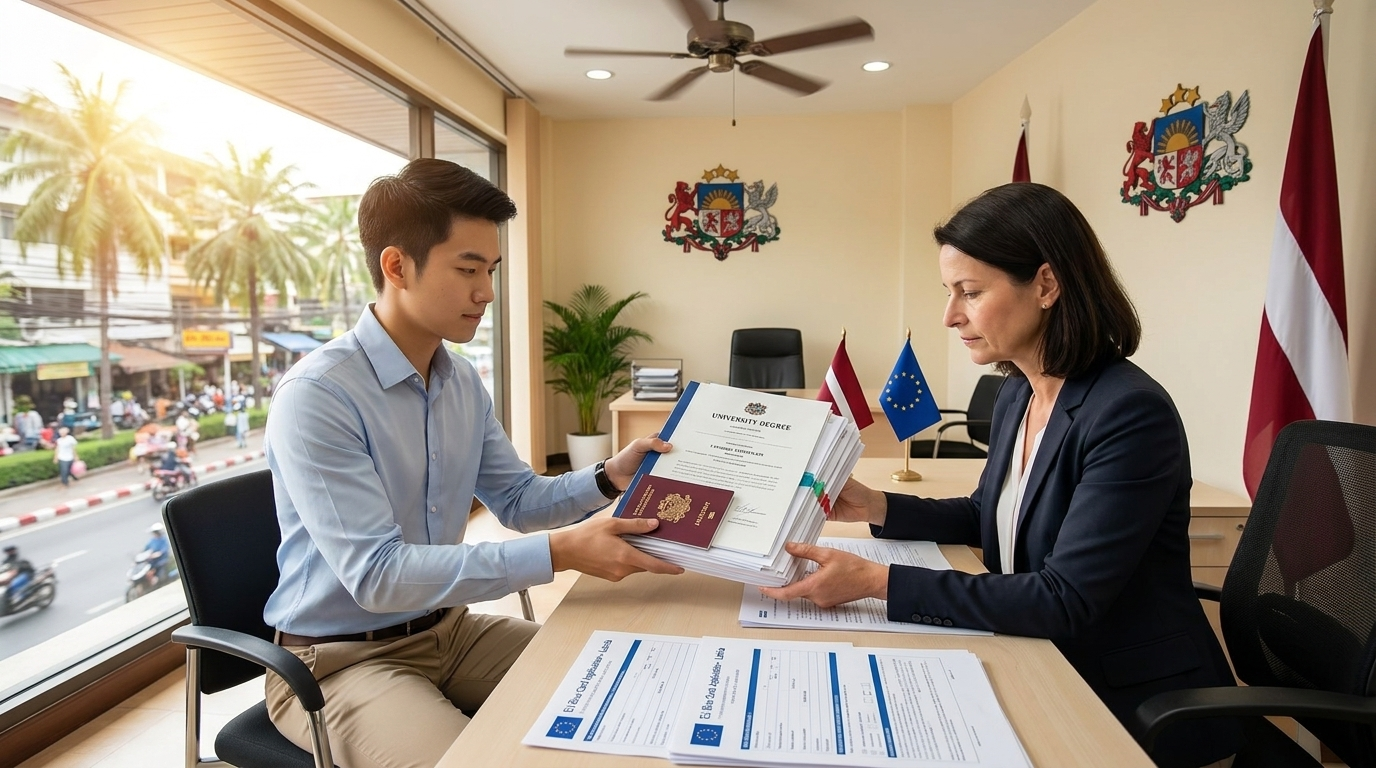
Step 4: Submit application at Latvian embassy or consulate
The application must be submitted in person at the Embassy of Latvia or Ministry of Foreign Affairs office in the applicant's country of residence. An appointment must be scheduled in advance. At the appointment, the applicant provides biometric data: digital fingerprints and a facial photograph. This biometric information is transmitted to OCMA and used to produce the physical residence permit card.
Step 5: OCMA processing and decision
Once the application is submitted, OCMA reviews the documents, verifies the applicant's eligibility, confirms the employer's registration with VID, and evaluates whether the role qualifies as a highly skilled position under EU Directive 2009/50/EC. OCMA may request additional documentation or clarification from the applicant or employer.
The typical processing timeline for an EU Blue Card application is 6 to 12 weeks from submission to final card issuance, though straightforward cases with complete documentation may be processed faster. The timeline includes initial embassy review (1-2 weeks), OCMA processing and decision (4-8 weeks), and residence permit card production and delivery (1-2 weeks after approval).
Step 6: Collect residence permit card and register address
After approval, the physical EU Blue Card is sent to the embassy or consulate for collection by the applicant. Once in Latvia, the cardholder must register their declared address with the local municipality office within one month of arrival and confirm that their employer has registered them with VID for personal income tax and social insurance contributions.
| Stage | Timeline | Key Actions |
|---|---|---|
| Degree recognition (if required) | 2-6 weeks | Submit degree to AIC; receive equivalence certificate |
| Document assembly and apostille | 2-4 weeks | Obtain criminal record, apostille, translate |
| Embassy submission and biometrics | 1-2 weeks | Schedule appointment; submit dossier |
| OCMA review and decision | 4-8 weeks | OCMA verifies employer, qualifications, salary |
| Card production and collection | 1-2 weeks | Collect card at embassy or OCMA office |

5. Can my spouse work in Latvia if I have an EU Blue Card?
Yes, spouses of EU Blue Card holders are generally granted open work authorization in Latvia without needing separate labor market approval. This is one of the key advantages of the EU Blue Card compared to standard employment permits. Under EU Directive 2009/50/EC and Latvia's implementing legislation, family members of Blue Card holders benefit from streamlined family reunification procedures and immediate access to the Latvian labor market.
Blue Card holders may apply for family reunification immediately upon receiving their card, without waiting for a minimum period of residence. Spouses and minor children are eligible for dependent residence permits, and these permits are processed faster than family applications tied to standard work permits.
Key benefits for spouses:
- Immediate work authorization: Spouses do not need to obtain a separate work permit or demonstrate labor market approval from the State Employment Agency (NVA). They may begin employment as soon as their dependent residence permit is issued.
- Faster processing: Family reunification applications for EU Blue Card holders are prioritized, with processing times typically ranging from 6 to 10 weeks.
- No augmented income threshold for one spouse: While standard permit holders must demonstrate increased financial sufficiency for each dependent, EU Blue Card holders' salary threshold (€2,500/month) is generally considered sufficient to support one spouse without additional augmentation, though this is evaluated case-by-case.
Required documents for spouse's dependent application:
- Valid passport
- Marriage certificate, apostilled and officially translated into Latvian
- Proof of the primary Blue Card holder's employment and residence permit
- Proof of accommodation in Latvia sufficient for the family
- Valid health insurance covering the spouse
- Criminal record certificate, apostilled and translated
Dependent residence permits for spouses of EU Blue Card holders are typically issued for the same duration as the primary Blue Card and must be renewed in coordination with the primary permit.

6. Additional Benefits of the EU Blue Card
Beyond the higher salary and immediate family work authorization, the EU Blue Card offers several strategic advantages for long-term career and residence planning within the European Union.
Enhanced intra-EU mobility
After holding an EU Blue Card and residing legally in Latvia for at least 18 months, the cardholder may apply for an EU Blue Card in another EU member state without returning to their country of origin. This significantly facilitates career mobility within the EU and allows highly skilled professionals to pursue opportunities across multiple member states while maintaining continuous legal residence status.
Accelerated path to permanent residence
EU Blue Card holders in Latvia may qualify for permanent residence after five years of continuous legal residence, the same timeline as standard permit holders. However, in some EU member states, Blue Card holders benefit from reduced timelines (as short as 21 months in Germany under certain conditions). While Latvia does not currently offer a reduced timeline, the Blue Card's documentation and compliance advantages often make renewal and permanent residence applications smoother.
Family reunification priority
As noted above, Blue Card holders can sponsor family members immediately and benefit from faster processing and open work authorization for spouses. Minor children also receive dependent permits and may access Latvian public education without additional authorization.
Cumulative residence across the EU
Time spent holding an EU Blue Card in one member state can count toward long-term residence eligibility in another member state under certain conditions. This cumulative residence principle allows highly skilled professionals to build toward permanent EU residence even if they relocate between member states during their careers.
Professional recognition and career flexibility
Because the EU Blue Card requires verified higher education qualifications and employer sponsorship for highly skilled roles, cardholders are generally well-positioned for professional recognition processes, licensure applications, and career advancement within their fields across the EU.
7. Practical Considerations and Common Pitfalls
While the EU Blue Card offers significant advantages, applicants should be aware of several practical considerations that can affect application success and long-term compliance.
Salary verification is strict
The €2,500 gross monthly salary threshold is non-negotiable. Employment contracts that show lower base salaries supplemented by bonuses, commissions, or other variable compensation may not satisfy the requirement. OCMA evaluates the guaranteed gross salary stated in the contract, and applicants should ensure the contract explicitly states the monthly or annual gross amount before submitting the application.
Job description must match qualifications
OCMA reviews the alignment between the applicant's degree and the job description. Generic job titles or descriptions that do not clearly require higher education qualifications may result in refusals. The employment contract should explicitly reference the applicant's educational background and describe duties that correspond to a highly skilled professional role.
Employer registration and financial stability matter
OCMA verifies that the sponsoring employer is registered with the Commercial Register, holds a valid VID taxpayer identification number, and has filed recent tax returns. Employers with outstanding tax liabilities, inactive business registrations, or no declared revenue are likely to trigger application refusals. Applicants should confirm their employer's good standing before beginning the application process.
Degree recognition delays can affect timelines
If the applicant's degree was issued outside the EU/EEA, the Academic Information Centre evaluation can add 2 to 6 weeks to the overall timeline. Applicants should initiate the recognition process as early as possible and factor this delay into their relocation planning.
Address registration and tax compliance are mandatory
EU Blue Card holders must register their declared address with the local municipality within one month of arrival and confirm that their employer has registered them with VID for tax and social insurance purposes. Failure to complete these post-arrival steps can complicate permit renewals and may result in administrative penalties.
8. Next Steps
If you are a highly skilled professional with a recognized higher education degree and a job offer in Latvia that meets the €2,500 gross monthly salary threshold, the EU Blue Card is likely your best route to legal residence and work authorization. The card provides immediate work authorization, faster family reunification, and enhanced mobility within the European Union.
Before proceeding, confirm that your degree is recognized by the Academic Information Centre (if issued outside the EU/EEA), verify that your employment contract explicitly states the gross salary and job duties requiring higher education, and ensure your prospective employer is registered and in good standing with the Commercial Register and State Revenue Service.
Want to hear what other clients
are saying about us?

Because the EU Blue Card application requires precise coordination of degree recognition, document apostille and translation, consular appointments, and OCMA processing windows, applicants often benefit from professional guidance to ensure all documents meet technical requirements and timelines align without delays.


